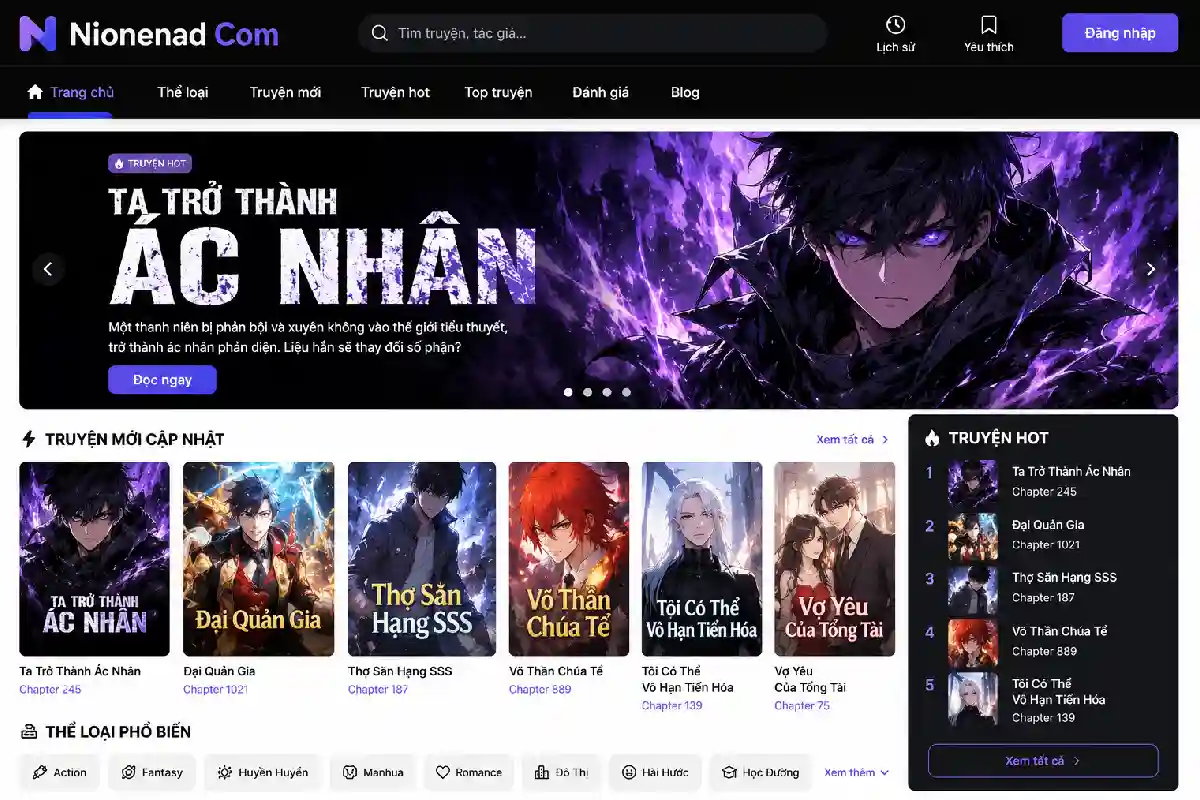
When searching on the Internet, reading articles, or following links from search engines and social media sites, people may encounter a website with a name that looks strange to them. For example, the search query nionenad com.
When the website or the domain name looks unfamiliar, people might find it hard to understand what kind of services or products are offered, who the owner of the website is, and whether the domain is safe to visit. The name of the domain is all that people see, and users cannot provide information for the verification of the website.
Thus, before providing any personal information, registering on the website, downloading anything, and even purchasing something, it is important to check the website.
The article will provide information on how to research an unfamiliar domain name, such as Nionenad Com, and the safety measures people may use to protect their personal information from theft.
Table of Contents
What Is Nionenad Com?
Nionenad com may indicate the website or the domain.
However, the domain name itself cannot provide people with information about the website and services.
It is necessary to check the website and all the information related to it.
Why Are Unfamiliar Websites Difficult to Evaluate?
There are millions of websites on the Internet.
Those are:
- Professional organizations
- Blogs of private persons
- Online stores
- Communities
- Educational websites
- Software platforms
- News websites
- Online advertising websites
And other kinds of websites that were created recently, are no longer active, are misleading, or are created to steal something from users.
How to Check the Domain Name of the Website Carefully
Let us start with the domain name of the website.
Look for:
- Typos in the address
- Unusual symbols
- Additional words
- Suspicious subdomains
- Redirections
- Additional domain extensions
It is important to pay attention to the address that is displayed in the browser.
Look for HTTPS
An HTTPS-secured website will encrypt the connection between your browser and the website.
Typically, HTTPS is recognizable from the lock icon or the https prefix in the browser address bar.
However, HTTPS does not necessarily mean that the website is authentic.
Fraudulent website owners may also obtain HTTPS certificates.
In this context, one needs to regard HTTPS as one security measure and not as proof of the website’s authenticity.
Check the Purpose of the Nionenad Website
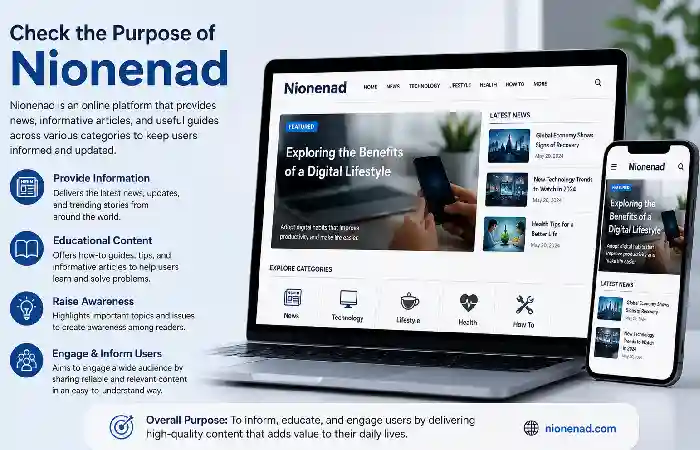
A legitimate website normally states its purpose clearly.
Consider:
- What does this website offer?
- Who is this website meant for?
- Whose company or organization runs it?
- Why does it need my information?
- How can I contact the owner?
If it is hard to determine this information, then it might be better to exit the website for further verification.
Look for Contact Information
A legitimate commercial website usually offers ways to contact the organization.
Check:
- Company name
- Business address
- Customer-support email address
- Phone number
- Contact form
- Social media
The existence of the contact information cannot serve as a guarantee of the authenticity of the website, but the lack of this information can be regarded as a red flag.
Check the About Page
An About page often gives useful background information.
Consider checking for:
- Company history
- About team members
- Information about location
- Service offered
- What the business does
Exercise caution when encountering vague claims on an About page.
Be Careful When Making Payments Online
If an unknown website asks you to pay for something, think twice.
First, check:
- The identity of the business
- Detailed information about a product/service offered
- Refund policy
- Payment processing service
- Contact information
- Reviews of other customers
Avoid paying for a website just because there is a payment option available.
Try to use the trusted payment options, which will create the necessary record of the transaction.
Avoid Unusual Downloads
Unknown websites can offer you various downloads including:
- APK files
- Browser extensions
- Application for desktop computer
- PDF files
- Media files
- “Security tools”
Downloading a malicious file might harm your device or expose your sensitive data.
Check Browser Warnings
New browsers can alert users when accessing a potentially dangerous website.
It is not recommended to skip a warning message without further analysis.
This kind of warning can be:
- The suspect of phishing
- Malware
- Unsafe downloads
- An invalid security certificate
- Concealed data
The most reasonable action is to leave the website until the reason for the warning is found.
Search for Independent Information
While searching for information about an unknown website, it is necessary to find independent information about the website.
This kind of information can include:
- Independent reviews
- Business directories
- News about the company
- Consumer complaints about it
- References to it by other companies
- A reliable social media presence
Special care must be taken regarding review websites where there are no negative comments and only generic praise.
Do Not Trust Reviews Blindly
While online reviews can be helpful, they can also be misleading.
When evaluating reviews, patterns need to be considered.
Possible warning signs are:
- Too many reviews posted at once
- Using identical wording
- Too generic praises
- No customer experience described
- Only five-star ratings
- No review of the product or service
An even distribution of reviews can provide more information.
Check Domain’s Age
Information about domain registration can sometimes help in analyzing the website.
The newness of the domain does not mean it is dangerous.
It is normal when a business starts its activity through a new website.
However, if a website pretends to be an established company while being created recently, it needs to be verified.
This information should always be analyzed together with the other pieces of evidence.
Be Aware of Unrealistic Offers
One of the easiest methods to identify a suspicious website is to analyze its offers.
Beware of claims like:
- Very big discount
- Profit guarantee
- High-priced free items
- Quick reward
- Employment guarantee
- Low price of electronics
- “Limited-time” pressure
An offer that seems unrealistic must be checked carefully.
Avoid Pressure Tactics
There are websites that put pressure on people to force them to do things before checking everything.
Such as:
- “Hurry Up”
- “Your account will Be Deleted”
- “Just 5 minutes Left”
- “Pay Now to Avoid Penalty”
- “Verify Your Account Right Now”
The deadline can be set in legitimate services, but do not let the pressure stop you from verifying the site.
Protect Your Passwords
In case you decide to open your account on an unknown site, you need to make a unique password.
Do not use your email password for another website. You can always ask a password manager to help you with generating a unique password.
If there is two-factor authentication on the site, you can also consider it.
Use Two-Factor Authentication
Two-factor authentication makes the process of logging into your account more difficult.
It is good at protecting your account even in case the password gets leaked.
Depending on the type of service, two-factor authentication will use:
- Authentication applications
- Security keys
- SMS
- Email verification
The authentication applications or security keys will be better than SMS, if possible.
Make Sure Your Device Is Up to Date
Security updates can fix:
- Operating system vulnerabilities
- Browser vulnerabilities
- Application vulnerabilities
- Vulnerabilities in security software
Update your computer and your smartphone. Using an old operating system can be very risky because of known security issues.
Use Security Software
The right security software can help you check for any malware and strange activity.
However, it does not substitute safe browsing.
A combination of:
- Updated software
- Secure passwords
- Safe browsing habits
- Two-factor authentication
- Downloads
will be much better.
What If You Already Visited an Unknown Website?
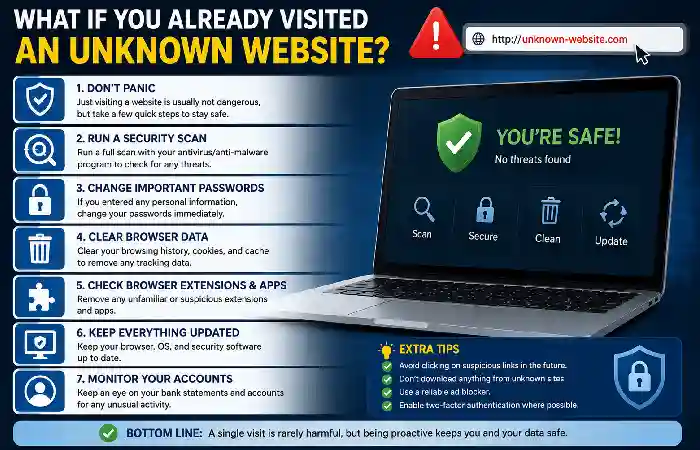
Just visiting a particular website does not automatically indicate that your device is under threat.
However, when you:
- Have input a password,
- Entered your card details,
- Downloaded a file,
- Installed software,
- Gave your OTP code,
- Connected your crypto wallet,
you should take further measures.
- If You Have Entered Your Password
- You should change the password right away if you have entered it on a doubtful website.
- If you have used this password somewhere else, you have to change passwords there, too.
- It is recommended to use two-factor authentication when possible.
- If You Have Provided Payment Information
- When you have entered your credit card or banking details on the website in question, contact your bank or the provider of your card.
- Tell them about the incident and find out what security measures you should undertake.
Check your account for unusual transactions.
When you have provided a UPI PIN or any other banking credentials, contact your bank as soon as possible using a legitimate phone number.
If You Have Downloaded a Suspect File
Do not open the file again.
Run a scan for malware using credible security software.
If you have installed an unknown application, think about disconnecting your computer from the Internet.
In case of serious threats, it is better to consult professional technical assistance.
If You Have Created An Account
If you have created an account using a password that you use elsewhere, you should change this password in all your accounts.
The website knows your email, beware of further phishing emails.
The attackers can try to use the gathered data to attack other services of yours.
How to Recognize Phishing Attempts
Phishing attempts resemble legitimate websites and organizations.
Such websites can have:
- The logo of the company,
- A similar domain name,
- A false login page,
- Requests to log in,
- Claims about urgent messages,
- Alerts about payments.
You should always check the real domain before logging in.
How to Research an Unknown Domain
An easy-to-use research process may come in handy.
Step 1: Examine the Domain Attentively
Take into account the spelling and the browser warnings.
Step 2: Find the Operator
Find the company or an organization that controls the website.
Step 3: Visit the “About” Page
Pay attention to the detailed information.
Step 4: See the Website’s Contacts
Verify that the contact information is correct.
Step 5: Study the Policies
Look at the privacy policy, refund policy, and terms page.
Step 6: Search for References
Find independent references about the website.
Step 7: Do Not Share Credentials
Provide no sensitive credentials to a questionable website.
Conclusions
The keyword “nionenad com” is not sufficient for determining the credibility and reliability of the website. While dealing with an unknown domain, one should always investigate the website before communicating with it.
It is important to examine the website carefully, find the operator, study the website’s policies, search for independent information, and do not provide credentials. HTTPS protocol, professional design, logo, and high search-engine ranking are not sufficient reasons for calling the website credible and reliable.
Whether you are researching a website to buy something, sign up for an account, download files, or obtain some information, the several minutes that you will spend investigating the website source may save you from unnecessary troubles regarding security and privacy.