

Testing is an important part of preventive care and can reveal valuable information about various aspects of one’s health. Various blood tests, urine tests, imaging, and health packages can help a medical professional understand the patient and come to the right conclusions.
Redcliffe Labs is a diagnostics lab in India that offers laboratory testing and various diagnostic services. This organization offers a variety of tests and health packages and also encourages the use of convenient services such as home sample collection.
Understanding the types of diagnostic services that are provided by diagnostic laboratories, the testing processes, and necessary considerations before ordering tests may help in choosing the right laboratory.
Below, you will find some information about Redcliffe Labs, typical diagnostic services, health checkups, home sample collection, preparations for the test, and important considerations when choosing the laboratory.
Table of Contents
What Is Redcliffe Labs?
Redcliffe Labs is an Indian diagnostic company that offers various testing and diagnostic services.
The services offered by the company are designed to help patients and medical professionals obtain information from diagnostic tests.
Depending on the location and availability of certain services, the customer can order individual tests, health packages, and even home sample collection.
Diagnostic laboratories can be used in many ways, such as regular screening, preventive tests, disease monitoring, and helping doctors assess the patient’s symptoms.
Why Are Diagnostic Tests Important?
Diagnostic tests can give a lot of information about various health aspects in a measurable form.
Depending on the type of test, laboratory analysis can give information about:
- Blood cells
- Blood sugar levels
- Cholesterol
- Liver functions
- Kidney functions
- Thyroid hormones
- Vitamins and mineral levels
- Properties of urine
- Some infections
- Etc.
Depending on the symptoms, medical history, age, lifestyle, or other factors, a doctor may prescribe certain tests.
Types of Tests Available of Redcliffe labs
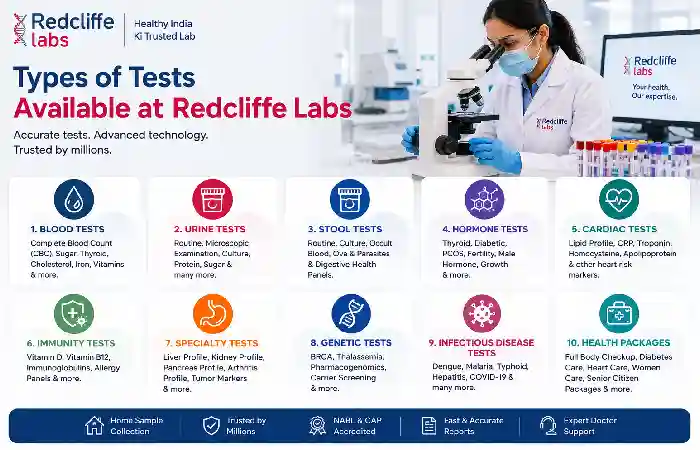
Diagnostic laboratories generally offer a broad range of investigations.
The exact test menu can vary according to the laboratory, city, collection center, and availability.
Blood Tests
Blood testing is one of the most common forms of laboratory investigation.
Depending on the test, a blood sample may be used to evaluate:
- Blood glucose
- Complete blood count
- Lipid profile
- Liver function
- Kidney function
- Thyroid function
- Vitamin levels
- Hormonal markers
The appropriate test depends on what a healthcare professional is trying to evaluate.
Urine Tests
Urine testing can provide useful information about several aspects of health.
Common urine investigations may examine:
- Appearance
- Glucose
- Protein
- Blood
- Specific gravity
- Other chemical or microscopic characteristics
A physician may recommend urine testing as part of routine screening or when investigating particular symptoms.
Preventive Health Tests
The preventive testing is aimed at early identification of potential health risks.
The health packages might consist of a number of independent investigations put together in a single screening program.
These tests might include:
- Test for blood sugar
- Cholesterol test
- Liver test
- Kidney test
- Test for thyroid
- Test for blood counts
The need for each of them might vary from person to person, and thus the optimal screening program should be established individually.
Packages of Diagnostic Tests
Numerous diagnostic service companies provide a variety of packages of health tests for those who would like to get several different tests in a package.
It is handy due to the possibility of organizing several investigations at once in a single booking session.
Before you choose a health package, you have to find out:
- What tests will be included.
- Whether you need to fast before the test.
- Whether you will be able to get a home collection of samples.
- How much time the generation of the report might take.
- Whether a doctor consultation is provided.
- Whether the package is suitable for your age.
The bigger package does not always mean a more useful one. The most relevant tests are the ones that suit personal health conditions.
Home Sample Collection
One of the handy services that has appeared in diagnostics is the home collection of samples.
Rather than visiting a laboratory collection center, a client can order a visit from a trained phlebotomist or collection professional at their home if possible.
Home collection can be handy for:
- Elderly clients
- Clients with difficulty moving
- Busy professionals
- Families with multiple tests to be done
- Those who prefer not to visit a collection center.
Redcliffe Labs Prices in India, London, Australia, Canada, or the USA
| Location | Redcliffe Labs Price Availability | Example / Price |
| India | Available | LFT: ₹399 (Red Cliff Labs) |
| London, UK | Not officially listed | — |
| Australia | Not officially listed | — |
| Canada | Not officially listed | — |
| America (USA) | Not officially listed | — |
How Home Sample Collection Works
It usually involves several steps.
- Choose a Test
Choose the necessary laboratory test or package of health tests.
- Give Your Details
Enter the necessary contact and address details.
- Choose a Time
Schedule an appointment during one of the available time slots if this service is offered.
- Preparation for the Test
Prepare according to the laboratory’s instructions.
For instance, some blood tests may need fasting.
- Sample Collection
A specially trained collector will collect the necessary samples.
- Laboratory Processing
The sample is delivered to the appropriate laboratory for processing.
- Receive the Report
After the processing of the sample, the report can be received via the delivery method used by the service.
How to Prepare for a Blood Test
The preparation process entirely depends on the specific test.
Some blood tests require fasting, while others do not.
In case of required fasting, the laboratory and health care professionals will give instructions about:
- What time to stop eating
- Whether you can drink water
- Whether you need to take medications
- Whether you have to avoid physical exercises
- The time to come for collecting
Do not discontinue your prescribed medication on your own because of a blood test.
Why Fasting Might Be Required
Food and drinks can affect some measures temporarily.
Sometimes, fasting will help to get more standardized results.
However, fasting is not required for all diagnostic tests.
The proper preparation will depend on the specific investigation, so you should follow the instructions for your appointment.
Understanding the Laboratory Reports
Receiving the laboratory report can be rather confusing sometimes.
It usually includes:
- Test name
- Test result
- Unit
- Reference range
- Laboratory comments
A test result outside the reference range does not necessarily mean that a patient has any disease.
Reference range is calculated depending on a particular laboratory’s methods and its population. In contrast, the result depends on many different things, such as age, gender, medications, timing, hydration, and physical activity.
What Is a Reference Range?
A reference range is the range of values commonly seen within a certain reference population.
The range of values stated on the laboratory report depends on the test conducted and the laboratory method applied.
Sometimes, two laboratories might apply different methods and different ranges for their reference ranges.
Therefore, it is better to consider the range of values printed on your test report and not a random one from the internet.
Choosing a Diagnostic Laboratory
When choosing a diagnostic service, consider factors other than cost.
They include the following:
Accreditation
Make sure the laboratory is accredited and adheres to proper quality measures.
Test Availability
Find out whether the laboratory conducts the particular test you want.
Sample Collection
Find out whether sample collection can be done in a convenient location and at home.
Time of Reporting
Find out how long the particular test will take.
Transparency
Consider the description of the test, its cost, preparation instructions, and the services offered.
Customer Support
A good diagnostic service will provide an opportunity for you to contact the service provider regarding appointments, test reports, and sample collection procedures.
Comparison of Prices
The cost of conducting a diagnostic test varies among laboratories and in different regions.
Before booking, compare:
- The cost of the particular test
- The package price
- The cost of home collection of samples
- Discussions
- The price of consultations
- Whether a repeat test is included
Even if the service is cheaper, it might not be the best because it does not have the required tests, quality measures, and convenience.
Diagnostic Testing for Women
Women need health screens in different stages of their lives.
Based on age, family history, symptoms, and advice of the healthcare professional, some investigations may be necessary, such as:
- Iron
- Thyroid function
- Blood sugar
- Cholesterol
- Vitamins
- Hormones
In case of pregnancy, some laboratory investigations are recommended by healthcare providers.
Diagnostic Testing for Men
Men can also undergo preventative health screens.
Based on different individual risks, the doctor may suggest investigations related to:
- Blood pressure
- Blood sugar
- Cholesterol
- Kidneys
- Liver function
- Thyroid function
And many others.
Testing for Older Adults
Regular medical monitoring can become increasingly important with age.
Healthcare professionals may recommend periodic laboratory investigations to monitor areas such as:
- Blood glucose
- Cholesterol
- Kidney function
- Liver function
- Blood counts
- Nutritional markers
Home sample collection can be particularly convenient for people who have difficulty traveling.
Children and Laboratory Tests
Children may occasionally need laboratory testing for diagnosis or monitoring.
Parents should follow pediatrician instructions regarding:
- Required tests
- Preparation
- Fasting
- Medication
- Sample collection
Children may require different reference ranges from adults, so laboratory reports should be interpreted using the appropriate pediatric ranges.
Common Mistakes Before a Diagnostic Test

A few simple mistakes can affect the testing process.
Ignoring Preparation Instructions
If fasting is required and the patient eats shortly before collection, the result may not be suitable for the intended purpose.
Exercising Intensely
Certain measurements can be influenced by strenuous physical activity.
Dehydration
Fluid status can influence some laboratory measurements.
Taking Supplements Without Mentioning Them
Some supplements can influence certain test results.
Tell your healthcare professional about relevant medications and supplements.
Assuming Every Test Requires Fasting
Not every test requires fasting. Follow the instructions for the specific test rather than following generic advice.
What Happens After Receiving a Report?
If the report contains an unexpected result, don’t panic.
The next step is usually to discuss the finding with your healthcare professional.
A doctor may consider:
- Your symptoms
- Medical history
- Previous test results
- Medications
- Physical examination
- Other diagnostic investigations
Sometimes an abnormal result is temporary or clinically insignificant. In other cases, it may require additional evaluation.
Can Laboratory Reports Diagnose Diseases?
A laboratory test will give you vital clinical information; however, a report will not diagnose you by itself.
Doctors always use lab results along with other information.
For instance, one measure of blood glucose needs to be interpreted in combination with your symptoms, medical history, previous tests, and type of test performed.
Therefore, do not self-diagnose based on an online interpretation of a laboratory report.
Storing Your Reports
Having your previous laboratory reports may be helpful.
A personal health record will help you and your doctor compare results over time.
Think about having:
- Reports on blood tests
- Imaging reports
- Prescription information
- Past diagnoses
- Your vaccination record
- Medical reports
Electronic copies may facilitate obtaining the needed information when visiting a doctor.
Securing Personal Information
Laboratory reports may contain sensitive personal data.
Do not upload your reports online on unknown sites to get their automated interpretation.
When sharing the report on the internet, keep in mind:
- Full name
- Phone number
- Address
- Patient IDs
- Registration number
- And any other personal information
Try to use healthcare channels where you can trust your health information.
Frequently Asked Questions
What is Redcliffe Labs?
It is a diagnostic healthcare provider in India that performs laboratory tests and other diagnostic procedures.
What tests are available at Redcliffe Labs?
The menu of available tests may consist of blood tests, urine tests, health packages, and other diagnostic investigations. Availability may differ from the place and procedure you choose.
Does Redcliffe Labs perform home sample collection?
Yes, home sample collection is available for certain eligible services and places. It is necessary to check the current availability when booking.
Do I have to fast before all blood tests?
No, there is no need. It depends on the particular test you are going to have. Follow the instructions for preparation.
How should I interpret my laboratory report?
Use the reference range printed on your report and discuss unexpected results with a qualified healthcare professional.
Is there any sense in having health packages?
Yes, it may be convenient. It is necessary to select the health package based on your medical needs and not on the number of tests performed.
What should I do if my result is abnormal?
It does not necessarily mean you have a disease. You should discuss it with your doctor.
Final Thoughts
Redcliffe Labs is an example of the increasing presence of organized diagnostics in healthcare today. From simple blood tests to home specimen sampling, diagnostic labs may make health monitoring more convenient and accessible.
However, it is essential to choose not the biggest package but the right test depending on the individual’s age, symptoms, health condition, physician’s recommendations, and the aim of testing.
It is necessary to review the pretest preparation, the procedure, sample collection methods, reporting timeframe, and cost of tests before going for any diagnostic examination. After receiving the test results, the report should be considered as a source of clinical data rather than a basis for self-diagnosis.
The combination of health monitoring and medical advice, along with a healthy lifestyle, will help individuals make informed decisions regarding their health.